04.11.2016En vogue at home and abroad
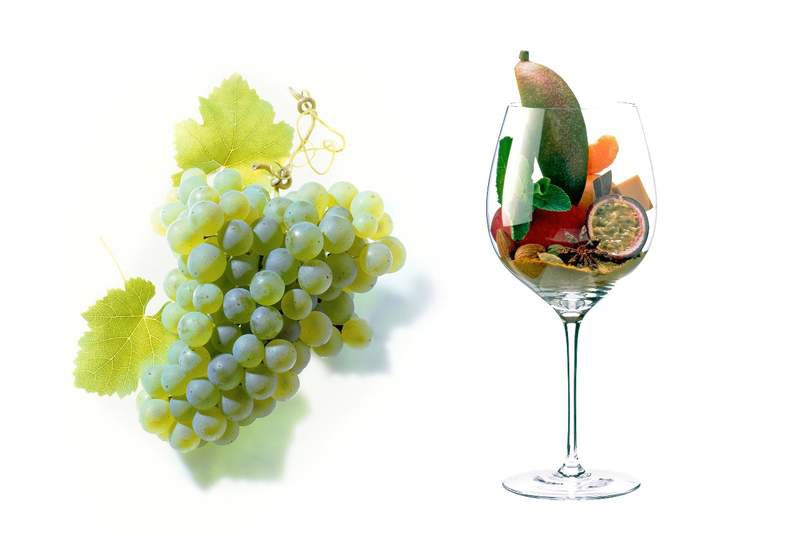
In the last ten years, aromatic grape varieties have been experiencing a bit of a renaissance both at home and abroad. The younger generation in particular appreciate their intense aroma, which comes with a pleasantly fresh fruit acidity in dry style with subtle sweetness.
Overview of the most important German aromatic varieties:
Scheurebe
In 1916 the grape-breeder Georg Scheu, working at the research institute in Alzey, produced an impressive new variety by crossing Riesling and Bukettraube. It became known as Scheurebe.
Of the approx. 1,400 hectares of German vineyard currently planted with Scheurebe, more than half (725 ha) lies in its “motherland” Rheinhessen, roughly 350 ha in the Pfalz, 150 ha in Franken and 100 ha in the Nahe. This makes it in terms of cultivation one of the most important of Germany´s aromatic varieties.
The pronounced aroma is typically reminiscent of blackcurrant (cassis), occasionally also of tropical fruits such as maracuja or mango. The noble sweet styles stand out for their long cellaring potential and great finesse. The different styles and quality levels make Scheurebe wines a versatile choice for many occasions. Light Kabinett wines are ideal for a social get-together, dry to medium-dry styles pair beautifully with aromatic and spicy Asian dishes and luscious Auslese or Beerenauslese and Trockenbeerenauslese wines are excellent partners for fruit-based desserts.
Sauvignon Blanc
Sauvignon Blanc is the shooting star of German white wines and can safely be called a fashionable grape. Total vineyard area in Germany has more than doubled from 2007 – 2015 to approx. 900 ha – with further potential upwards. Plantings are distributed mostly around the wine-growing regions of the Pfalz (380 ha), Rheinhessen (240 ha) and Baden (120 ha).
This white variety was actually most common in southwest France, where it was first documented in 1710. But in the last few decades it has spread widely around the globe.
The signature feature of Sauvignon Blanc is its powerful aroma of grass, herbs, gooseberry and green fruits. It pairs excellently with asparagus, fish dishes and seafood, or even pasta with cream sauces.
Gewuerztraminer
Gewuerztaminer is a monument of German wine culture that has survived for centuries. In the Pfalz wine village of Rhodt there is a Gewurztraminer vineyard with approx. 400-year-old vines. This cultural monument alone indicates that Gewuerztraminer is one of the oldest varieties still cultivated today. Historical documents in Germany provide proof of its existence in the 16thcentury; at that time there was a planting recommendation for the variety.
Gewuerztraminer was cultivated on approx. 940 ha in Germany last year and has experienced a bit of a comeback in the last few years (2010: 690 ha).
The largest areas under vine are in the Pfalz (400 ha), in Rheinhessen (170 ha) and in Baden (150 ha), with the emphasis on the Kaiserstuhl. In Sachsen, Gewuerztraminer is considered a regional speciality and is grown on 6 per cent of the vineyard area.
Gewuerztraminer seduces the wine drinker with its scent of roses and sometimes one also finds notes of violets, honey and marzipan. Noble-sweet Auslese wines are suitable for long-term cellaring. As a vintner Sekt (bottle-fermented sparkling wine) or pomace brandy, it is a very special treat.
The intense aroma, complemented by a spicy fruit flavour, makes Gewuerztraminer a variety for lovers of aromatic wines. Dry and medium-dry styles go well with Asian dishes or game paté and spicy, aromatic ragouts. Mature and luscious examples are popular as an aperitif. Sweet Spaetlese and Auslese wines are excellent with aromatic desserts, as well as those made with marzipan or chocolate. The combination of Gewuerztraminer and the Alsatian Munster cheese or blue cheese is a particular delight.
Muskateller
Muskateller is one of the oldest white wine grapes, whose origins can in all probability be traced back to Asia Minor. The Muskateller family has many variants – there are more than 200 distinct varieties worldwide. In this country Gelber Muskateller is the most common variant, with 310 ha of vines found mostly in the Pfalz, Baden and Wuerttemberg. Other well-known variants include Roter Muskateller, Goldmuskateller and Rosenmuskateller.
Muskateller derives its name from the typical musky aroma that is characteristic of the taste of the grape. However, the aroma spectrum of Muskateller wines goes much further and ranges from elderflower to exotic fruits. Its lively fruit acidity means that it can still taste fresh when it is made in a lusciously sweet style. Similar to Gewuerztraminer, it is an excellent partner for Asian and Indian dishes, as well as spicy cheeses.
See also the report: Wine Institute honours best aromatic wines
Photo: © DWI

22.05.2019Leave your stresses and strains behind

21.05.2019More than 190 partners

20.05.2019Bavaria’s hotel brand for connoisseurs

17.05.2019On the trail of nobility

16.05.2019Wellbeing in Bayern

15.05.2019Culture, nature and culinary delights of Allgäu/Bavarian-Swabia

13.05.2019A great experience, whatever the season!

08.05.2019Many advantages and free entrances

07.05.2019Hot time, summer in the city
06.05.2019Lake Constance Gardens tell stories.
03.05.2019No chance for a boring holiday!

02.05.2019Relaxing and inspiring

29.04.2019Inn or gourmet restaurant - always tasty!

26.04.2019Stuttgart’s Market Hall and Markets

25.04.2019The contrast between Frankfurt and its surrounding environs is typical of the Rhine-Main region
24.04.2019Creative hotel concepts with a sophisticated design

23.04.2019Many events to experience

18.04.2019The Romans started it
17.04.20195 great gardening experiences in Southwest Germany

16.04.2019Positive results in 2018

15.04.2019Big festivals and the picturesque Christmas Market are traditionally held in the state capital.

11.04.2019Jewish culture – important heritage but also actively experienced
09.04.2019Vineyards, Wineries and Wine Queens

08.04.2019What’s awaiting visitors in 2019?

05.04.2019Enjoy coffee.

04.04.2019Specialists for Enjoyment.
03.04.2019Two Guide Michelin 2019 star-awarded restaurants in Frankfurt

02.04.2019The New Old Town has brought a piece of Frankfurt history back to life!

01.04.2019Together with other German cities, Leipzig celebrates the 100th anniversary of the Bauhaus school
29.03.2019Lake Constance Region: New Offers